Archive for the ‘Bit of politics’ Category

h1

Before we start…

March 18, 2015

… can I just ask a small question.

WTF?

No, seriously, I mean, why are we doing this again?  What is the point of running the policy teams in Treasury and HMRC ragged, spending all that money on producing and promulgating a Budget, when there’s going to be an election and a change of government in forty nine days anyway?

The new government will no doubt want to do the same thing all over again later in the year.  (Next time, please don’t call it an “emergency budget” though.)  And, pedantry corner, yes, there will be a change of government whatever the result of the election.  The current coalition isn’t up for re-election: the status quo is not an option.  The individual parties that make up the current coalition might conceivably, if the maths came out just so, decide to reconvene but would nevertheless have to hammer out a different coalition agreement.

So.

Why not quietly do a competent Finance Bill based on the material that’s already out there: the things announced in the last Budget and in the autumn, that have been subject to consultation and had their unintended consequences examined?  Why faff about announcing a load of stuff that’s just designed for the manifesto, that won’t be enacted if controversial or will be overturned if expedient?

Because, politics.

Yes, all right.  I’ll be watching (and live tweeting) this afternoon anyway.  I have pizza.  See you on the other side.


h1

Prosecuting tax evasion is hard. Because, evidence.

February 14, 2015

Prosecuting tax evasion is hard.  Or at least, I imagine it is.  Because in all my time in the Inland Revenue and HMRC, I was never involved in a prosecution case.

Prosecutions are dealt with by a separate bit of the department.  Because, evidence.

Say I looked at a set of accounts and asked for some backing documents and then someone sent me a document that was a forgery.  Should they have been prosecuted?

Say it was an appeal: say they told me they’d appealed.  Say the thing they sent me was backdated to make it look like they’d appealed in time, and I spotted it was a forgery – could prove it was a forgery, in fact, because it referred to a thing that hadn’t happened at the purported date of the document.  Should they have been prosecuted?

What would their defence have been?  We actually did send in the appeal on time, but we couldn’t put our hands on it when you asked us?  A junior member of staff made a copy from our computer files but obviously they shouldn’t have done it and we’re very sorry, but that doesn’t alter the fact that we made the appeal in time and the dog ate our copy and why can’t you find YOUR copy, HMRC?  Is your filing system SO chaotic?

Say failing to make the appeal on time would have cost them £100.  Should they have been prosecuted for a measly hundred quid?  Would that have been worth the cost of prosecution in the first place?

Would the forged document even have been admissible as evidence?  We hadn’t had any conversations under PACE, they hadn’t had legal advice when they spoke to me, I hadn’t had any training in PACE except for the basic “this thing exists, you have to get it right, so refer to prosecutions if you think you’ve found something that needs this kind of handling” training.

It’s not as easy as it first sounds… except….

Well, except that obviously an overworked prosecution section has to prioritise.  Say they are so under resourced they can only take cases where there’s a million quid of tax at stake: would you even waste their time asking them about a forged document that £100 hangs on?

What should have happened, in an ideal world?

Well, shouldn’t there have been a prosecution unit attached to every team?  Resourced to investigate the smaller cases, under PACE, with a view to prosecution?  To prosecuting the tax cheats (and I mean the direct tax cheats, not the fag smugglers and VAT dodgers on the “most wanted” list) with the same kind of limits as the benefit cheats?

Instead of me arguing with them about their accounts and a district inspector shouting at them about the attempted forgery, maybe their accounts should have been examined with a view to prosecution and they should have been hauled in and interviewed under PACE.  It still might not have been a serious enough case to be worth prosecuting, but there’s a space between a hundred quid and a million where, surely, there ought to be some equivalence between the limits we set on benefit fraud and the ones we set on tax fraud?

Wouldn’t that bring in 25 times more than it would cost to run?  Why aren’t we doing that?

[Edited 14/2/15 because the headline should have read “evasion”, not “avoidance”.  Thank you, twitter! *beats head on desk*]

h1

Small firms impact: not waving but drowning [Part 2 of 4]

February 5, 2015

A TIIN is supposed to answer seven questions.  (They are here in the TIIN instructions – the TIIN instructions still aren’t published by HMRC – and why not??? – but let’s assume the basic principle is still the same as “in my day”.)

The questions are:

What are you doing?

Why are you doing it?

Why are you doing it this way?

What will it cost/raise?

What will it cost the customer?

What will it cost the department?

Are there any other impacts?

“Why are you doing it” is a powerful question in the “better regulation” mindset, which basically reflects a worldview in which regulation is a Bad Thing in and of itself.  The idea is that regulation is nothing more than Red Tape, which would be Strangling Business unless it was itself regulated.  “Why are you doing it (at all)” is really the question, if you think that having no regulation at all is the ideal.

So why is the government doing MOSS at all?  Well let’s see.  The policy objective field of the TIIN (still on page A111) is where the answer ought to be, and it says:

Policy objective The measure will make business to consumer (B2C) supplies of BTE services taxable where they are consumed, thereby removing an incentive for businesses to locate offshore. This will level the playing field for UK BTE suppliers and is consistent with the Government’s aim of fairness in the tax system. The MOSS business simplification scheme is intended to reduce the administrative burdens and costs associated with this rule change and multiple VAT registrations for BTE suppliers, particularly for small and medium enterprises (SMEs).

Translated into English, I think this means there are two objectives:

  1. The main objective is to stop big companies from gaming the system by setting up shop somewhere with a low VAT rate.  Instead of VAT being charged where the supplier is located, from January 2015 it is charged (for electronic services like e-books) where the customer is located.  So small companies should have a more “level… playing field… consistent with the Government’s aim of fairness…”
  2. Because this change comes with associated costs for small companies, there will also be the “mini one stop shop”, the MOSS, which stops you having to register for VAT separately in each member state and instead handles it all in once place, the place the seller is located.

Now, I think the objectives are good ones in themselves.  Let’s make it easier for authors to sell their own works, for craftswomen to sell their own knitting patterns, for musicians to sell their own tunes, directly to the customer without having to lose a slice of their profits to a multinational selling for them.  And, yes, let’s keep the administration as simple as possible.

So what went wrong?

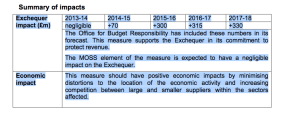
Let’s go back to the TIIN, to the summary of impacts that starts at the bottom of page A112.
Screenshot 2015-02-05 14.14.50

The first line shows you how much money the government expects to get as a result of this change.  The numbers are in millions of pounds, and the plus sign means the government expects to get this much tax in from the change.

The first few months of 2015 are still in the 2014-15 tax year (the tax year runs from 6th April one year to 5th April the next year).  So between January 1st and April 5th 2015 the UK government estimates it will make £70 million in VAT from the changes.  In a full year, it thinks it will make an extra £300 million plus, with the numbers rising over time.

I think we can all agree three hundred million is a sum worth having.  For the government, it’s the cost of, say, the entire NHS radiotherapy service (table 9 page 28, 2011-12 figures).  But look at this: “The MOSS element of the measure is expected to have a negligible impact on the Exchequer.”

Now, I understand “negligible” in an impact assessment to mean “less than £100,000 across the entire affected population”, which is what it used to mean in 2012 when I was last working for the government.  But have a think about that.  The entire farrago of MOSS is expected to bring in less than a hundred grand?  Seriously?

Because one of the seven questions written into the tax original impact assessment proposals, and which was still there when I obtained the TIIN instructions and published them on my blog, is

why are you doing it this way???

Why the hell are you imposing this business-busting system on people from whom you expect to raise peanuts, when you’re still going to get the moolah you want from the big businesses it’s really aimed at?  Is this really the only way?

Option appraisal is one of the key elements of impact assessment methodology: generating and assessing all the possible ways of solving a possible policy issue and then choosing the best one, even if it’s the option to “do nothing” – that’s how governments tell themselves they solve problems.

So where is the options appraisal in this TIIN?

Don’t bother to look.  It isn’t there.

Look instead at the assessment of the economic impact.

This measure should have positive economic impacts by minimising distortions to the location of the economic activity and increasing competition between large and smaller suppliers within the sectors affected.

Well perhaps it “should”.  In an ideal world it would.  But in this imperfect world, HMRC completely overlooked the one-woman kitchen-table microbusiness and introduced a system which, far from “minimising distortions” and “increasing competition” will in fact wipe out the micro businesses or else drive them into the arms of the very businesses whose behaviour caused the policy problem in the first place.

A proper options appraisal might have included:

  • excluding micro businesses from the regulation altogether
  • allowing a longer lead in time before the regulation affected small and micro businesses
  • unilaterally setting a threshold below which the regulations do not apply
  • making payment processors legally responsible for operating the regulation
  • devising a MOSS which itself operated as a payment processor for micro businesses (instead of a paypal or worldpay etc button you could have a MOSS button – your money would come to you VIA the government, but come to you guaranteed VAT-compliant)

There might have been good reasons for and against any or all of these.  But if you don’t ask the right questions of the right people, well, you’ll never know, will you?


h1

Tax doesn’t have to be taxing?

February 3, 2015

Look, I’m an ex-inspector of taxes.  Of course I left my tax return to the last minute, and of course I finished up doing it on Saturday (the last possible day to avoid penalties) and of course I got stuck and had to ring the helpline.

(By the way, HMRC, you might want to look again at section 4.  When you’re customising the return you’re asked
Screenshot 2015-01-31 17.06.40


Well of course I said yes, because I have an occupational pension.  But then I spent a good hour baffled by section four itself, which says

Screenshot 2015-01-31 17.08.20


I mean, OK, it was five o’clock on the day the tax return was due, but I managed to get through to the helpline with no trouble.  The trouble was that the helpline didn’t know where to enter an occupational pension either!  The answer is, hit send (leaving all the boxes blank) and you will, eventually, get to the secret page 2 of part 4 which has a space for occupational pensions.  Try a bit of signposting please!

While we’re about it, where the hell do you get off with this page?

Screenshot 2015-01-31 17.12.38I don’t have a repayment due.  But you can’t get past this page of the return without entering your bank details or lying that you don’t have one at all.  Now, that may be administratively convenient for you, and I have given you my bank details before when I have been due a repayment.  But I’d very much like to know how you have the right to demand my bank details as part of my return?  Anyone?  Bueller?)

Anyway.  I finished my return, paid the tax, and sat back waiting for the Inner Peace to descend.

It didn’t.

Because, you know, when I worked on the CIS scheme, we were very proud of the groundbreaking way that the contractors’ monthly returns were pre-populated with the details of their subcontractors already known to HMRC.  And, to be honest, the thing that took me longest in preparing my return, was trying to find the P60 with my pension details on it, which I clearly have put in the Proverbial Safe Place and no doubt it’ll turn up in time for me to make an amendment.

But why am I struggling to find a piece of paper on which are written numbers that I’m going to type into a computer system so that someone in HMRC can check them against the information they already have?  Is there any compliance risk from me putting the gross payments I received into my bank account, or last year’s figures, or an estimate of some other sort into my return, given that the tax has already been paid and there’s nothing that would tip me into another tax bracket?

What I mean is: why isn’t my return pre-populated with the pension and other employment details that HMRC already knows?

I suspect it’s because the HMRC computer isn’t one big shiny Skynet or Deep Thought but, like most large organisations’, it’s a patchwork of parts,  a bundle of bits and bobs of hardware and software, tied together with goodwill and fingers crossed. To put the information HMRC already know about my pension into my actual return and feed it back to me would involve… spending more money than anyone has lying about.

The old Inland Revenue was cutting edge with its computer technology, back in the seventies. Since then all the computer experts have been made redundant and privatised, so now the giant Aspire contract and the complicated web of suppliers and operators means no-one really knows how it all works. When the contract comes to an end wouldn’t it be nice to replace the outsourcing? I know, I know, that would count as an increase in Civil Service numbers and we can’t have that, can we?

But it might cost less in the end. And I might not have to spend my January Saturday afternoons cursing a system that has to ask me to type in information that it already knows.

h1

The Emperor’s Clothes

January 22, 2015

I’m a great believer in the saying that there are no stupid questions.  So here’s a stupid question: what about Quantitative Easing?  No reason, just they were talking about it on the lunchtime news and saying that the Bank of England had “created” £375 billion of money out of nothing, used it to buy bonds, in the hope of getting the banks to lend money to businesses and get the economy moving.  And that it didn’t work.  It’s all about “injecting money into the economy” apparently.

£375 billion.  There are about 64 million people.

Why don’t they just give everybody £5859 (give or take 37p) and inject it where it would do some good?  (£375bn/64m, which my calculator thinks is 5859.37, assuming I put my decimal point in the right place)

You know.  If they can really make money out of nothing.  Which apparently they can.  [Economics make my brain hurt at this level.]  But I think it’s more likely to stimulate the economy if I can have enough money to pay my university fees AND go to Wiscon, than if the banks have, er, more gilts and other incomprehensibles.

Apparently one of the expectations of QE is that “Purchases of financial assets financed by central bank money should initially increase broad money holdings, push up asset prices and stimulate expenditure by lowering borrowing costs and increasing wealth”. (p201)

So.  Is it an “Emperor’s new clothes” question to ask why giving me five grand which I promise faithfully to spend spend spend wouldn’t do the same thing.  Only better.  And be MUCH more fun?

h1

Cost and value

January 21, 2015

How much does it cost to employ someone?

Let’s say an average wage is £27,000 – the kind of wage an officer in the Civil Service might get, for example.

The employer pays £27,000 plus employer’s NICs of around 3726 (£27k x 13.8%).  Call it about £30726 (ignoring other costs like accommodation, insurance…).

The employee gets a tax free allowance of £10,000 and a NICs threshold of 5772 and pays tax at 20% and NICs at 12% on the rest.  Say £3400 and £2548 respectively.

So the employer pays £30726 of which the employee gets £21,052 to take home and the government gets £9674.

OK.  Now.  Suppose the person doesn’t have a job.  Instead, they’re unemployed.  How much does that cost?

The government pays the person £72.4 a week in JSA.  They also pay them things like housing benefit (or temporary help with mortgage interest payments, if they become unemployed after they have started buying a house)  Those amounts depend on the person’s personal circumstances and I’ve run a few different scenarios through the helpful gov.uk benefits calculators.  If I were single with no dependants and no income and living in my current house with my current mortgage and council tax, then apparently I might be entitled to £157 a week in JSA, mortgage interest help and council tax support.  That’s £8164 a year (and, yes, is time-limited and dependent on circumstances but I take it to be a reasonable proxy for the sort of sum an ordinary working person might be entitled to)

Now let’s look from the point of view of the government.

Because of course the government doesn’t actually “pay” £30726 for an employee at £27000 a year.  The tax and NICs go back to the government, so the effective cost to the government is the amount the employee takes home, i.e. £21052.

And the difference between employing a Civil Servant on £27k and having them sit on JSA must, logically, therefore be the difference between £21052 and £8164, that is £12,888.

You see where I’m going with this, of course?  The government actually gets twenty seven grands-worth of work for twelve and a half grand.

Which is why, in the middle of a recession, it’s a daft idea to consider civil servants purely as a cost and not also as a benefit.

What kind of benefit?  Aside from the benefit of having money circulating in the economy, the well-being of the person employed in a proper job, and the virtuous circle of having working people in work and spending their money on fares to work, sandwiches at lunchtime and new clothes in which to look professional?

Well let’s think about tax penalties for a minute.  There is a bit of a theme developing in the tax press about penalties: are they fixed at the right levels?  Are they being used for a sensible purpose?  Are they actually achieving the objective of changing behaviour?

Here’s an idea.  Instead of letting trivial penalties mount up till they’re “worth” collecting, why not employ a new cadre of – let’s call them “advisory collectors”.  Send them out, in pairs, to knock on the doors of people who have incurred £100 penalties for failure to make CIS returns, or are late with their income tax self assessments, or have incurred 2% or 5% VAT penalties for an amount smaller than £400.  Let them collect the relatively small amounts of penalties due, and at the same time give advice and assistance to prevent the problem recurring or the penalties accumulating.

Useful work, I’m sure you’ll agree.  Why, they might even pay for themselves…

h1

Slow motion car crash

January 20, 2015

I’m sorry to keep banging on about the VAT thing.  It’s just… compulsive.  Like watching a slow motion car crash.  I genuinely don’t understand how we got to where we are, and how it is that the tax profession seems to be utterly complacent that everything is working as it should and that small businesses are whinging unnecessarily.

Look at this, for example, via writer and academic Juliet McKenna, pointing out a KPMG report on its research into readiness for the VAT place of supply changes, and its findings that more businesses are flailing than are ready.   I particularly draw your attention to its statement that “156 businesses responded including small-sized (less than £10m turnover)…”

In a world where a ten million pound turnover makes you “small”, what price the nano businesses where ten thousand pounds is a good year?

What we are talking about here is administrative burden.  “Administrative burden” is a technical term in impact assessment although it’s often simply referred to as “red tape”.  Essentially it’s the cost of complying with government regulation, and there’s a reasonably coherent principle behind it.  If you or I spend an hour filling in our tax returns it doesn’t cost us actual money; we spend our leisure time on that instead of on reading a book or watching Wolf Hall and we complain but we aren’t left worse off in financial terms.  If a business spends an hour filling in tax forms, however, it undergoes an actual cost, because there is one hour of staff time spent on administration that could otherwise have been spent on profit-generating activity.

However alongside that there is a much bigger proportionate cost to smaller businesses than to larger businesses.  If a business with a million pound turnover has to spend £1000 of staff time on filling in VAT returns it has lost 0.001 of its turnover.  If a one-woman kitchen-table nano-business has a turnover of £10,000, it has lost a tenth of its turnover – and there are viable part time “bonsai” businesses with turnover of £1000 or so, which form a useful supplement to family income, and which will of course be completely wiped out.

I don’t have an answer.  But I have some questions, first of which is – where is the tax profession?

h1

OFCOM consultation

January 14, 2015

Now this one?  This one is worth responding to.  I urge you to go here (link to the response form) and have a few words, even if you can’t be faffed to read the whole condoc.

It’s the OFCOM consultation on their daft proposal to count UKIP as a “major party” in the next election but not to count the Greens.  Aside from giving Cameron an excuse to weasel out of the leadership debate, it’s simply bad policy.  The Welsh, Scottish and Northern Irish parties are counted in their respective countries but not nationally, so we’ll leave them aside for the moment.  But the Greens have had an MP in the Commons since the 2010 election, whereas UKIP’s two MPs both date from this parliament and were, respectively, turncoat tories who won Orpington Man-style by-elections caused by their own defections.  Logically, to me, you either count both parties as having broken through to “major” status, or neither.  But counting UKIP and not the Greens?  That’s just… daft.

There are three questions to which OFCOM are seeking answers: here they are, together with my answers.

Question 1: Please provide your views on:
a) the evidence of current support laid out in Annex 2, and
b) whether there is any other relevant evidence which you consider Ofcom should take into account for the purposes of the 2015 review of the list of major parties

I do not believe polling data (other than votes in actual elections) should determine coverage in elections.

Question 2: Do you agree with our assessment in relation to each of:
a) The existing major parties,
b) Traditional Unionist Voice in Northern Ireland,
c) The Green Party (including the Scottish Green Party), and
d) UKIP?
Please provide reasons for your views.

a) yes b) no opinion c) No: on the strength of having an MP elected at the general election and of being (on the evidence of local councils etc) a national party, the Greens should be considered a major party. d) No: to me, the same conditions apply to the Greens and to UKIP. I have no objections to UKIP being included on the same terms as the Greens, but I object strongly to their being included and the Greens excluded on the basis of commercial (and therefore inherently not neutral/impartial) polling data.

Question 3: Do you agree with the proposed amendment to Rule 9 of the PPRB Rules Procedures outlined in paragraph 3.7 above? Please provide reasons for your views.

I am not entirely clear from the wording of the consultation document on how the change would work in detail. It seems to me sensible that a party or representative of a party should not be able to use up OFCOM’s time and resources by making frivolous or malicious complaints, but I would be against the decision resting purely on the say-so of the Chair of the Election Committee (if that is, indeed, the intention.)

The consultation is open till 5th February so you have time to have a look, and I would urge you to do so.  I think they got this one wrong, and we might well be able to get them to look again and get it right.

h1

Google-fu

January 7, 2015

I subscribe to various things on the They Work For You website, and one of the interesting things that popped up today was a written question to David Gauke on the VATMOSS problem:

Stephen McCabe, Shadow Minister for Education, asked “what assessment his Department has made of the potential of the changes which come into force on 1 January 2015 on VAT rules for small and micro businesses in the UK which sell digital products to other EU member states.”

To which the response is “I refer the honourable member to my reply to his question number 219172”

Now, maybe I’m just having a bad day, but I’m genuinely baffled.  I can find the question 219172, but I’m hornswoggled if I can find the answer!

I’m not hopeful it’ll be anything other than blah blah blah, but I’m an impact assessment specialist and if I can’t find it, what chance do the rest of us have?  Someone like the friend I had lunch with, say, who doesn’t actually have an internet connection at home?

They work for us, right?

(But if anyone out there can find it, please post a link in the comments!!!!)


h1

Sometimes, good news is bad news.

January 6, 2015

I was watching the Autumn statement in the gender studies institute of the LSE alongside other members of the Women’s Budget Group when George Osborne said  “And what’s happening to the gender pay gap? It’s just fallen to its lowest level in the entire history of this country.” I’ve never actually heard the sound of so many collective jaws dropping before.

What actually seems to have happened is that the gap went up a bit the year before, and then back down a bit last year.  But only if you take the government’s preferred measure, of the difference between men’s and women’s full time median earnings.  If you actually take into account the actual wages of actual people – you find that women tend to work part time more often than men because, biology (and sociology).  And the government’s “gender pay gap” doesn’t include them ohoh.

And then again as the Joseph Rowntree foundation noted:

So effectively what we were looking at was a bullshit statistic covering downwards convergence.  Trust me, the kind of feminism represented in the WBG isn’t about wanting to close the pay gap by making men poorer but by women richer.  Or as one tweeter pithily put it:

Anyway, the Women’s Budget Group report on the Autumn Statement is out now and can be read here.