Archive for the ‘Consultation’ Category

h1

Sheffield Bus Partnership

July 30, 2015

No, I’d never heard of it either, and I actually live in Sheffield.  But I noticed a pale sign on the bus that read

NETWORK CONSULTATION

We’re improving Sheffield’s bus services.

Tell us what you think about our proposed new network in our public consultation from

6 July to

31 July 2015

Travelsouthyorkshire.com/sbp

Now, let’s take a moment to spot the weasels in that notice.  First of all, it was a pale blue notice with no graphics of any kind on it; nothing designed to catch the eye.  The text was white on blue, but the dates of the consultation were black and I had to look twice to see them.  The whole thing might as well have said “nothing interesting to look at here: move along please”

And we’re “improving” Sheffield’s bus services: so no need to worry your pretty little heads about it?

Tell us what you think about a “proposed new network”: sounds like something boring and bureaucratic that doesn’t have anything to do with you, probably.

Travelsouthyorkshire.com/sbp – not even a “for more details go to…”, just the web address.  Which, I might point out, is hardly helpful to people without net access.  Who tend to be older, poorer, less well educated than the average of the population.  (And, if we are to believe the ageist and classist quote, might align with the bus user demographic, if it’s really true that “A man who, beyond the age of 26, finds himself on a bus can count himself as a failure” attributed to Thatcher  Speaking as a regular bus user myself, I don’t think so…)  But my point is that the consultation itself is unlikely to reach the very people on whom it might have an impact.

Note also that the consultation is open for less than a month, and that Sheffield University’s 2014-15 session ended on 13th June – so all the students, another big bus user demographic, had already gone home.

Right then: let’s have a look at the actual consultation.

First thing to notice? Well, there are face to face drop in sessions – definitely following best practice there – but how is anyone supposed to know about them?

Secondly… well, where IS the consultation?  There isn’t a consultation document that I can find – nothing with a summary explaining what the rationale for change is, what changes are being proposed and what will be the likely impact.  Instead there are two leaflets; one for the north of the city and one for the south – what if your bus journey crosses this imaginary boundary?

Let’s have a look at the north first.

Your views are important and will be used to help us make sure the network offers the best travel options for the people in the city before it is introduced at the end of October 2015

OK, what’s wrong with that sentence?  If our views are important, why are they being sought only to confirm the changes before they are introduced? Isn’t best practice in consultation to consult only on things which you have the capacity to change?  If everyone emails in today saying these plans are awful, is there the capacity to pause the implementation date and re-think the plans?

Then there’s a map.  I can’t read it online (it’s either too small to pick out any of the detail, or else too detailed to pick out the overall picture.)

Then there is a table of individual route numbers and a brief note about the changes made to each.

The document for the south is identical: same rubric, different map, different table; full of helpful details like

20 Hemsworth – Norton Lees – Heeley – Lowfields – Sheffield – Burngreave – Northern General – Southey Green – Parson Cross – Ecclesfield: Revised route replacing 97/98 between City centre and Ecclesfield

20A 9A,18,20 See route details for 9A, 18, 20 — — — Service replaced by 9A/18/20

There is no overall document, no explanation of the rationale for the changes and their impacts.

How do you respond to the consultation?  The ONLY method offered is to complete a form, either online or on paper.  I had a look at the form.  Here it is.  Go on, have a look.  Now, I’m a better regulation specialist, and in my professional opinion that is NOT a consultation response document: it’s a consumer survey.

3.4 How much would you be willing to pay for a multi-operator ticket allowing you to use all buses?

Nothing
5% more
10% more

(Yes, London friends, I know you manage to have an Oyster Card system you can use on buses and local trains and trams, and there are a billion journeys.  We in the sticks have two rival bus and tram companies who can’t manage to share ticketing revenue from, er, quite a lot less)

On a purely selfish basis I won’t be responding, as the only bus which I regularly use is “service unchanged”, and I don’t respond to marketing surveys.

But as an example of How Not To Do A Consultation?  I think I’ll be referring back to this quite a lot.
h1

The day after

May 8, 2015

There are 61 open consultations today, still the same 5 from HMRC and 8 from HMT.  So nothing new from either department being snuck out on election day.  There must have been a couple which passed their closing date and fell off the “open” list (and dear god in heaven is gov.uk ever going to work out how to let us filter them in the order in which they close????) because there is also a new one today from the Airports Commission (we have an airports commission???) on air quality.

I’m assuming the Airports Commission is some kind of quango with continuity that means the election passed it by.  Because otherwise it’s an extraordinary time to be pushing condocs out there, surely?

h1

A new day

May 7, 2015

Well, election day, actually.  I’ve been and voted, and now I’m ready for a marathon night watching the results.  I know, I know, I’m sad like that; and, of course, I’m semi-retired so I don’t have to be anywhere tomorrow so I can sleep in as long as I like.

You would think, in the hiatus between governments, that all would be quiet on the consultation front.  I logged on to gov.uk out of sheer curiosity, thinking it would be interesting to see the consultation page with the counter set to zero.

But no!  There are, in fact, some 62 open consultations listed.  I don’t know about you, but I feel that 62 new laws and regulations would be a reasonable score for an entire parliamentary term, not the number of residual bits of leftover legislation not important enough to wait for the end of purdah.  Can we just STOP making new law and try administering the ones we’ve got for a bit?

Sigh.

Of the 62 open consultations I have no objection to odds and ends of measures like Natural England consulting on restricting access to, for example, Widdybank Fell (which looks very nice, by the way).  The world would still continue turning even if we didn’t have a government, (Belgium managed OK for 541 and then 135 days, after all) and so I suppose there’s no reason to stop the process of consulting.  But I could have lived without seeing a serious consultation into reform of the Government Ombudsman service, a paper on what I suspect is the first salvo in the war of the next BBC licence fee and a call for evidence on creating a secondary market in our bloody pensions sliding quietly out while all our backs are turned to the polling station.

Anyway.

HMRC has five open consultations:

and the Treasury has eight, two of them also on the HMRC list, five which (from a quick look, anyway) aren’t connected with tax, and one which may be of interest: Travel and subsistence review.  But which closes on 1 May 2016 at 11:45pm.

2016? Seriously?  I suspect it should read 2015 and it’s an already closed consultation.

It’s the twenty first century.  Keeping and maintaining an up to date list like this shouldn’t be this hard, surely?

Dear New Government: please get someone to make gov.uk work.  Thanks.


h1

Consultation: simplification at last

April 1, 2015

Considering that the provisional title of my PhD is “tax simplification and better regulation”, and that the original purpose of this blog was to monitor and respond to all tax consultations, I’m a little embarrassed to have missed this one.  It’s big.

In what will presumably be the last consultation document published by the Coalition, “A simpler tax system: the fast track to delivery” there are some far-reaching proposals put forward for simplification of the tax system.  This is a surprisingly radical attempt to achieve, at a stroke, the first of the Coalition’s priorities for its tax policy making (which, I’m sure we all recall, were that tax should be simpler, fairer, greener and more competitive).

As anyone involved in taxation knows, there have long been calls for the tax system to be simplified, and as anyone involved in tax policy making knows, it isn’t as easy as it looks. Anyone who gains by tax simplification is unlikely to show any gratitude to the government responsible, whereas anyone who loses under simplification is likely to be vocal in their opposition. However in a gratifyingly statesmanlike-display of cross-party agreement, the new proposals are being put forward in a multi-lateral document endorsed by all the major parties and are widely expected, if enacted by the next administration, to bring about a major simplification of business and personal taxes across the UK.

Building on the proposals in the Budget document “Making Tax Easier: the End of the Tax Return” where there is the aspiration that “it will feel like paying a single tax“, the change – in a project provisionally named unitary taxes – will retain all existing taxes and national insurance, but move to a per person, rather than a per tax, administration. Everyone will have a basic allowance of £12,000 below which they will not pay any tax on any income, gains or transactions. Between £12,001 and the current VAT threshold of £81,000 they will pay 20%, whether on income from employment or self employment, gains from capital transactions or interest on investments. Between £81,001 and £120,000 the rate will be 40% and from £120,001 it will be 60%. There will be no mansion tax, but neither will there be any exemption from capital gains for only or main residential property with the gains from any house sales folded into the unitary tax.  There will be no exemptions, allowances nor deductions – a change likely to have serious repercussions in the savings industry but which was perhaps foreshadowed in the Budget announcement of abolition of tax on the first £1000 of interest payments. The section on ISAs in the consultation document is particularly radical, consisting of three words: “ISAs are out”.  There will be some interesting recalculations to be done with the dramatic adjustment to the inheritance tax thresholds as inheritance tax, too, becomes subject to a one-off unitary tax charge on the estate of the deceased, bringing virtually all estates into its remit.  And of course capital gains tax planning is likely to prove challenging with the abolition of all possible reliefs, whether farming, entrepreneurs or even the minor chattels exemptions and merger of its thresholds with the single unitary threshold.

VAT will remain largely unchanged with its threshold remaining static and the current rules and rates remaining untouched.  However the total exemption for small and micro businesses from the revisions to place of supply rules is a surprising concession and it seems that there will be a further document after the election, on a similarly multi-lateral basis, proposing further radical simplifications including the abolition of all reduced and zero rates and the removal of all alternative calculation methods.

It is perhaps the changes to National Insurance (NI) which are the most radical.  In future NI will be charged at a single rate on all earnings, gains and transactions.  There will be no upper or lower thresholds, and the rate will change annually.  It will be calculated by taking the previous year’s total expenditure on pensions, disability and unemployment benefits (but not in work payments like housing benefit or working tax credits) plus the total cost of the NHS and of personal care provision, and then dividing this by the previous year’s unitary income.  Although National Insurance receipts will always lag behind National Insurance Payments (as pensions and benefits will in future be known) there will be a clear link between them.  If at any point the rise in GDP is such that unitary NI receipts are greater than the previous year’s NI expenditure the excess will not be used to reduce the following year’s rate but to start a sovereign wealth fund, with the intention of, ultimately, building up a capital sum sufficient to make abolition of NI payments altogether feasible, although the timescale is, it has to be said, ambitious.

Preliminary costings in the accompanying TIIN for this radical package seem rather optimistic, in that they suggest an administrative burden saving of more than a billion pounds and an exchequer impact of zero. Furthermore the economic impact appears to assume that the entire tax avoidance industry will close its doors at once and its employees and partners be immediately re-tasked to economically useful activity, thus creating a 5.8% spike in GDP.

Root and branch tax simplification has been the subject of much hopeful persiflage in the past but there have been few concrete proposals. Although these proposals are radical and the numbers are, to say the least, sketchy, it is to be hoped that the tax industry will respond to the consultation in the spirit in which it is put forward. In future, who knows, we may thumb through our slim pamphlets of tax legislation and look back on today as the end of an era.

h1

Tiresomeness

February 19, 2015

You know what?  There’s too much legislation.  Not just tax legislation, all legislation.  No-one has time to read it all, yet we are all presumed to know and understand it, because ignorance of the law is no defence.  And if you have been watching the programme about what goes on Inside the Commons you will have seen why.  Who has the time, in amongst the running down corridors to be shepherded into the right lobby to vote and camping out in empty offices to get to the front of the queue for a Private Member’s Bill slot (have these people never heard of computers?)

Parliamentary scrutiny is supposed to be the way that Bills are turned into Acts of Parliament – a series of formal debates take place with select committee scrutiny in between and so anything that comes out of the process has been scrutinised by our elected representatives and that’s democracy, right?

Yeah, right.

Parliament isn’t fit for purpose, or at least not for THAT purpose.  The House of Commons is a generator of heat, not light.  Even the way the building is designed confirms it, with two sides sitting opposite each other at a distance calculated to prevent them *sticking each other with swords*.

Which is why the process is vital.  By the time the Bill gets to the floor of the House, all the democratic scrutiny should already have been facilitated.  If it is a regulation, then there should be an impact assessment to show what the proposed change will cost and why the particular option has been chosen.  There should have been a public consultation where all the unintended consequences were bottomed out.  There should be an explanatory memorandum showing what the regulation is intended to achieve and assuring Parliament that all the necessary processes have been followed (there’s a good explanation of what ought to be in the EM at paragraphs 18 onwards here, in the House of Lords Secondary Legislation Scrutiny Committee’s guidance:

The purpose of the EM is to provide members of Parliament with a plain English, free-standing, explanation of the effects of the instrument and why it is necessary)

So consultation is important.  Oliver Letwin told the Legislation Scrutiny Committee that debates in parliament were the bedrock of democracy (so it didn’t really matter if he cut the time allowed for consultation, because consultation wasn’t the place to gather public “views”)  But I disagree.  I think democracy is, perhaps not quite broken, but a bit battered and bent round the edges, and that a consultation process before changes get as far as the Commons is a good sticking plaster.

Which is why it pisses me off that, three years after I suggested it to the Legislation Scrutiny Committee and they made it one of their recommendations, you still can’t get a list of consultations ordered in the date they will close.

I mean, it’s not rocket science, is it?

h1

Small firms impact: not waving but drowning [Part 2 of 4]

February 5, 2015

A TIIN is supposed to answer seven questions.  (They are here in the TIIN instructions – the TIIN instructions still aren’t published by HMRC – and why not??? – but let’s assume the basic principle is still the same as “in my day”.)

The questions are:

What are you doing?

Why are you doing it?

Why are you doing it this way?

What will it cost/raise?

What will it cost the customer?

What will it cost the department?

Are there any other impacts?

“Why are you doing it” is a powerful question in the “better regulation” mindset, which basically reflects a worldview in which regulation is a Bad Thing in and of itself.  The idea is that regulation is nothing more than Red Tape, which would be Strangling Business unless it was itself regulated.  “Why are you doing it (at all)” is really the question, if you think that having no regulation at all is the ideal.

So why is the government doing MOSS at all?  Well let’s see.  The policy objective field of the TIIN (still on page A111) is where the answer ought to be, and it says:

Policy objective The measure will make business to consumer (B2C) supplies of BTE services taxable where they are consumed, thereby removing an incentive for businesses to locate offshore. This will level the playing field for UK BTE suppliers and is consistent with the Government’s aim of fairness in the tax system. The MOSS business simplification scheme is intended to reduce the administrative burdens and costs associated with this rule change and multiple VAT registrations for BTE suppliers, particularly for small and medium enterprises (SMEs).

Translated into English, I think this means there are two objectives:

  1. The main objective is to stop big companies from gaming the system by setting up shop somewhere with a low VAT rate.  Instead of VAT being charged where the supplier is located, from January 2015 it is charged (for electronic services like e-books) where the customer is located.  So small companies should have a more “level… playing field… consistent with the Government’s aim of fairness…”
  2. Because this change comes with associated costs for small companies, there will also be the “mini one stop shop”, the MOSS, which stops you having to register for VAT separately in each member state and instead handles it all in once place, the place the seller is located.

Now, I think the objectives are good ones in themselves.  Let’s make it easier for authors to sell their own works, for craftswomen to sell their own knitting patterns, for musicians to sell their own tunes, directly to the customer without having to lose a slice of their profits to a multinational selling for them.  And, yes, let’s keep the administration as simple as possible.

So what went wrong?

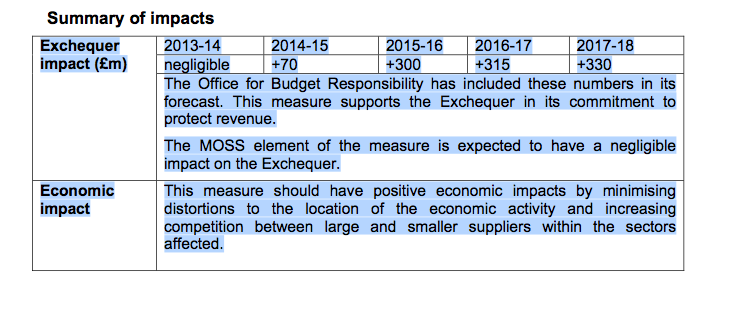
Let’s go back to the TIIN, to the summary of impacts that starts at the bottom of page A112.

Screenshot 2015-02-05 14.14.50

The first line shows you how much money the government expects to get as a result of this change.  The numbers are in millions of pounds, and the plus sign means the government expects to get this much tax in from the change.

The first few months of 2015 are still in the 2014-15 tax year (the tax year runs from 6th April one year to 5th April the next year).  So between January 1st and April 5th 2015 the UK government estimates it will make £70 million in VAT from the changes.  In a full year, it thinks it will make an extra £300 million plus, with the numbers rising over time.

I think we can all agree three hundred million is a sum worth having.  For the government, it’s the cost of, say, the entire NHS radiotherapy service (table 9 page 28, 2011-12 figures).  But look at this: “The MOSS element of the measure is expected to have a negligible impact on the Exchequer.”

Now, I understand “negligible” in an impact assessment to mean “less than £100,000 across the entire affected population”, which is what it used to mean in 2012 when I was last working for the government.  But have a think about that.  The entire farrago of MOSS is expected to bring in less than a hundred grand?  Seriously?

Because one of the seven questions written into the tax original impact assessment proposals, and which was still there when I obtained the TIIN instructions and published them on my blog, is

why are you doing it this way???

Why the hell are you imposing this business-busting system on people from whom you expect to raise peanuts, when you’re still going to get the moolah you want from the big businesses it’s really aimed at?  Is this really the only way?

Option appraisal is one of the key elements of impact assessment methodology: generating and assessing all the possible ways of solving a possible policy issue and then choosing the best one, even if it’s the option to “do nothing” – that’s how governments tell themselves they solve problems.

So where is the options appraisal in this TIIN?

Don’t bother to look.  It isn’t there.

Look instead at the assessment of the economic impact.

This measure should have positive economic impacts by minimising distortions to the location of the economic activity and increasing competition between large and smaller suppliers within the sectors affected.

Well perhaps it “should”.  In an ideal world it would.  But in this imperfect world, HMRC completely overlooked the one-woman kitchen-table microbusiness and introduced a system which, far from “minimising distortions” and “increasing competition” will in fact wipe out the micro businesses or else drive them into the arms of the very businesses whose behaviour caused the policy problem in the first place.

A proper options appraisal might have included:

  • excluding micro businesses from the regulation altogether
  • allowing a longer lead in time before the regulation affected small and micro businesses
  • unilaterally setting a threshold below which the regulations do not apply
  • making payment processors legally responsible for operating the regulation
  • devising a MOSS which itself operated as a payment processor for micro businesses (instead of a paypal or worldpay etc button you could have a MOSS button – your money would come to you VIA the government, but come to you guaranteed VAT-compliant)

There might have been good reasons for and against any or all of these.  But if you don’t ask the right questions of the right people, well, you’ll never know, will you?


h1

Small firms impact: not waving but drowning [Part I of 4]

February 4, 2015

Let us all wave to the House of Commons *waves* and then again to the House of Lords *waves*, our law makers.  Let us ask them to look again at a couple of the bits of paper that have been put in front of them and which have gone through on the nod.

Let’s start here, with a parliamentary question asked by David Morris, the Conservative MP for Morecambe and Lunesdale, on 22nd January.  Now I know nothing about Mr Morris beyond his website (the government has a Hairdressing Council?  Seriously?) and his wikipedia entry (and I can’t say I’m that sanguine about the veracity of all of that!) but Parliament.uk, usually a reliable source, gives small business as one of his interests.

So good for him, asking about the VATMOSS assessment of the impact on small business.

David Gauke’s reply was to refer him to the TIIN, published (on page A111 of the package of TIINs published on 10 December 2013 to accompany the draft clauses of the 2014 Finance Bill)

Let’s pause for a minute while you open up another screen, click on the link, and find page A111.  You might want to print it out, because we’ll be referring to it a fair bit over the next couple of entries.

Now to start with, what are we looking at here?  What is a TIIN?  Well I happen to know, because I was in the team that kind of accidentally invented the TIIN, when I was in charge of the Impact Assessment programme for tax measures.  An impact assessment is a formal document assessing the costs and benefits of making a regulatory change, and don’t get me started there (that’s what my PhD is about, amongst other things) and has to be done according to fairly strict protocols.  If you’re interested, there’s a hundred and eight pages of guidance you can access from this link (It was only 95 pages in my day).

At the point the coalition government came into office, there was a proposal to change the impact assessment template to make the format much tighter – to compel you to put an actual number to the costs/benefits and to put the numbers into the same format, essentially so that BIS could track the numbers across the whole government.  But that kind of impact assessment isn’t particularly helpful for tax changes, because the amount of tax raised or foregone is normally much greater than the administrative burden of the change itself.  So there was a lot of internal civil service politics around whether tax changes should be in or out of the new system, and this coincided with the move to improve the process of tax policy making itself, and the outcome was the invention of a tailored tax impact assessment process… but at the last moment the Treasury decided they wanted to combine the tax impact assessment with the Budget Note which HMRC used to produce explaining tax changes, and so we wound up with the Tax Information and Impact Note, the TIIN.

The TIIN, then, should explain what is being done and why, and include an assessment of the costs and benefits – to the exchequer, to the “customer”, and to HMRC.  It should also give the outcome of any other impacts which have been assessed, including equalities and other impacts to which governments have committed themselves (see the list on page 34 here and on page 66 here)

So.  David Gauke is telling us – is telling Parliament, in fact – that this TIIN contains the government’s assessment of the impact of the VATMOSS changes.

Let’s see what it says then, shall we?

First of all, look at the bottom of the first page, “background to the measure”.  This says:

Background to the measure

The measure was announced at 2013 Budget. Business input has been provided through joint business/HM Revenue & Customs (HMRC) groups.

Now, if you have been following the #VATMOSS #VATMESS hashtags or the articles in Taxation about POSMOSS you will know that one of the principal complaints of the micro and nano-businesses whose kitchen table businesses are likely to be wiped out by the change is that they were completely overlooked in the consultation process.  So who was representing small businesses on these “joint business/HM Revenue & Customs (HMRC) groups”?

I honestly don’t think that’s an unreasonable question to ask.

So I asked it.  On November 25th last year I sent a friendly email to the person who is named as the contact on HMRC documents, saying that it might well just be my google-fu was lacking but I couldn’t find the minutes of these meetings online as I’d expect so could he please point me to them?  I thought it was more than likely that the links was buried somewhere on gov.uk but just in case it wasn’t, I said if they weren’t yet published, would he please consider this a Freedom of Information Act request?

I had no reply.  But then I’d guessed at his email address (HMRC email addresses are usually in the format firstname dot lastname @hmrc.gsi.gov.uk but they can vary, after all) so on 11 December I put the request in formally via the HMRC Freedom of Information Act “portal” and had an acknowledgement telling me that

A response is being prepared and the statutory deadline is 13 January 2015.

On 21 January I sent another polite reminder asking why I hadn’t had a reply yet.  And on 30th January I received a reply.

Apparently

The external membership consisted of: Publishing: 3 small businesses Online Gaming: 2 small businesses Digital Services: 4 small businesses Other sectors/organisations: 3 representatives

but

I do not consider that there is a particular public interest in releasing the names of the micro or small businesses/organisations involved.

Now just a minute…

There used to be a handy page on the HMRC website that listed all the consultative groups, with links to their minutes and memberships.  It’s not there on gov.uk (well if it is, I haven’t found it yet!) but some individual groups are.  Look, here’s the Joint Customs Consultative Committee, the Research and Development Consultative Committee, the Joint VAT Consultative Committee (which, oh look, discussed MOSS on 8th May 2014…)

Are we seriously arguing that it’s a secret who the government talked to about introducing VAT MOSS?

No-none is planning on descending on the consulted businesses with pitchforks and torches – no responsibility resides with someone being consulted in answering for themselves and their own knowledge.  But there is a HUGE responsibility on HMRC and other government departments to ask the right people – to seek out and talk to the affected businesses.

Yes, I’ll be following up the FoI request – watch this space – but the arrogance (or defensiveness?) of saying there’s no public interest in knowing who HMRC consulted with, when the whole point of the outcry is that there are large numbers of people saying “I’m affected!  Who was representing me?”…. well, I think it’s just staggering.

h1

OFCOM consultation

January 14, 2015

Now this one?  This one is worth responding to.  I urge you to go here (link to the response form) and have a few words, even if you can’t be faffed to read the whole condoc.

It’s the OFCOM consultation on their daft proposal to count UKIP as a “major party” in the next election but not to count the Greens.  Aside from giving Cameron an excuse to weasel out of the leadership debate, it’s simply bad policy.  The Welsh, Scottish and Northern Irish parties are counted in their respective countries but not nationally, so we’ll leave them aside for the moment.  But the Greens have had an MP in the Commons since the 2010 election, whereas UKIP’s two MPs both date from this parliament and were, respectively, turncoat tories who won Orpington Man-style by-elections caused by their own defections.  Logically, to me, you either count both parties as having broken through to “major” status, or neither.  But counting UKIP and not the Greens?  That’s just… daft.

There are three questions to which OFCOM are seeking answers: here they are, together with my answers.

Question 1: Please provide your views on:
a) the evidence of current support laid out in Annex 2, and
b) whether there is any other relevant evidence which you consider Ofcom should take into account for the purposes of the 2015 review of the list of major parties

I do not believe polling data (other than votes in actual elections) should determine coverage in elections.

Question 2: Do you agree with our assessment in relation to each of:
a) The existing major parties,
b) Traditional Unionist Voice in Northern Ireland,
c) The Green Party (including the Scottish Green Party), and
d) UKIP?
Please provide reasons for your views.

a) yes b) no opinion c) No: on the strength of having an MP elected at the general election and of being (on the evidence of local councils etc) a national party, the Greens should be considered a major party. d) No: to me, the same conditions apply to the Greens and to UKIP. I have no objections to UKIP being included on the same terms as the Greens, but I object strongly to their being included and the Greens excluded on the basis of commercial (and therefore inherently not neutral/impartial) polling data.

Question 3: Do you agree with the proposed amendment to Rule 9 of the PPRB Rules Procedures outlined in paragraph 3.7 above? Please provide reasons for your views.

I am not entirely clear from the wording of the consultation document on how the change would work in detail. It seems to me sensible that a party or representative of a party should not be able to use up OFCOM’s time and resources by making frivolous or malicious complaints, but I would be against the decision resting purely on the say-so of the Chair of the Election Committee (if that is, indeed, the intention.)

The consultation is open till 5th February so you have time to have a look, and I would urge you to do so.  I think they got this one wrong, and we might well be able to get them to look again and get it right.

h1

First consultation response of 2015

January 9, 2015

Well this is odd.  The consultation on the withdrawal of another tranche of extra-statutory concessions (which closed at 11.45pm yesterday, 8th) was listed on gov.uk here.  There was one document to download, this one, which describes itself as a “technical note and call for evidence” and says

To date six consultations have been published seeking comments on such legislation, and a seventh is published today alongside this technical note.

Honestly, I wish they’d proof read this stuff!  I know they still have a consultation coordinator but perhaps “being irritatingly poorly proof read” isn’t a criterion for quality control.  That is, assuming the document actually *is* the consultation, and that there isn’t another document floating around somewhere on the HRMC website which didn’t make it across to gov.uk?

Anyway.

Here are the three concessions to be withdrawn.

EIM4 03002 – Professional remuneration

Sports testimonials

D45 – Capital Gains Tax: roll-over into depreciating assets

The first one seems to have been a “get out of operating PAYE” concession for DEFRA when they employed vets, so frankly I don’t care, sorry.  The third one has just been overtaken by new legislation and is plain obsolete.

The middle one?

Well you can see that a gentlemanly agreement to hold a testimonial match for Jenkins when he retired as the goalie for Obscurely Interesting United and returned to his full time employment as the local butcher might have made it appropriate to exclude the take from tax in the 1920’s.   This would be on the grounds that any monies Jenkins might have received were in respect of his sterling personal qualities and not an expected reward for his professional services.  But today?  When the pampered princes of the beautiful game could buy a house like mine every week from their earnings, can separate out their “image rights” (and keep them offshore), well, the belief that setting up a testimonial committee was sufficient to give them another tax-free sum wasn’t really in the spirit of the concession.

Yes I’m prejudiced: if just one of the Premier League players had put his hand in his pocket and sponsored the GB deaf women’s team’s fundraising efforts to go to the Deaflympics – funds they could have put in out of small change – I might feel differently.

On the other hand, the impact assessment says that

We understand that most of the bigger football testimonials will donate to charity – most of the Premier League testimonials noted recently have donated all funds raised (after costs incurred by the testimonial committee) to charities of the player’s choosing. In the bigger rugby and cricket testimonials up to 10% can be donated. These donations should not be adversely affected if individuals are encouraged to give using tax efficient methods such as Payroll Giving or Gift Aid, or by giving up all rights to the income.

And it’s in the impact assessment, so it must be true.

h1

Legislative gap? Legislative overload?

January 8, 2015

There’s a theory doing the rounds that the Coalition have run out of steam and are just coasting to the election date.  (7 May – in case you hadn’t heard!)

So where is the evidence?

You know where I’m going with this, right?  Yes, there are 2336 “publications” according to the front of the gov.uk consultations page today, of which 125 are open consultations (and, check figure, 2209 show up as “closed consultations“.  What are the other two???)

It’s January 8th today, the Thursday of the first full week back at work after the New Year for most people.  Quiet time, right, for catching up and getting organised?

Filter by “open consultations published after 1/1/2015” and you’ll find nine publications, ranging from how to comment on open access restrictions at Bickerley Common (which is a place in Hampshire where people walk their dogs but where birds like Bewick’s swan need to be protected from, er, eutrophication, whatever that is) to the Competition and Markets Authority’s draft Welsh Language Scheme which is out for consultation here (and which worried me a bit till I realised it was also out for consultation here in actual Welsh!)

Is that a lot, in a week?

I don’t know.  There were ten publications between 1/1/14 and before 9/1/14, and more organisations are migrating their web presence to gov.uk all the time.  There were 23 between the first and ninth of July (16 consultation outcomes and 7 new consulations) so maybe that’s about the going rate.

I don’t know.

It just seemed interesting to look at, that’s all.  As you were.

(But if you’re interested there are 9 open consultations about tax.  And this one closes at quarter to midnight tonight!)