Archive for the ‘HMRC’ Category

h1

Small firms impact: not waving but drowning [Part 2 of 4]

February 5, 2015

A TIIN is supposed to answer seven questions.  (They are here in the TIIN instructions – the TIIN instructions still aren’t published by HMRC – and why not??? – but let’s assume the basic principle is still the same as “in my day”.)

The questions are:

What are you doing?

Why are you doing it?

Why are you doing it this way?

What will it cost/raise?

What will it cost the customer?

What will it cost the department?

Are there any other impacts?

“Why are you doing it” is a powerful question in the “better regulation” mindset, which basically reflects a worldview in which regulation is a Bad Thing in and of itself.  The idea is that regulation is nothing more than Red Tape, which would be Strangling Business unless it was itself regulated.  “Why are you doing it (at all)” is really the question, if you think that having no regulation at all is the ideal.

So why is the government doing MOSS at all?  Well let’s see.  The policy objective field of the TIIN (still on page A111) is where the answer ought to be, and it says:

Policy objective The measure will make business to consumer (B2C) supplies of BTE services taxable where they are consumed, thereby removing an incentive for businesses to locate offshore. This will level the playing field for UK BTE suppliers and is consistent with the Government’s aim of fairness in the tax system. The MOSS business simplification scheme is intended to reduce the administrative burdens and costs associated with this rule change and multiple VAT registrations for BTE suppliers, particularly for small and medium enterprises (SMEs).

Translated into English, I think this means there are two objectives:

  1. The main objective is to stop big companies from gaming the system by setting up shop somewhere with a low VAT rate.  Instead of VAT being charged where the supplier is located, from January 2015 it is charged (for electronic services like e-books) where the customer is located.  So small companies should have a more “level… playing field… consistent with the Government’s aim of fairness…”
  2. Because this change comes with associated costs for small companies, there will also be the “mini one stop shop”, the MOSS, which stops you having to register for VAT separately in each member state and instead handles it all in once place, the place the seller is located.

Now, I think the objectives are good ones in themselves.  Let’s make it easier for authors to sell their own works, for craftswomen to sell their own knitting patterns, for musicians to sell their own tunes, directly to the customer without having to lose a slice of their profits to a multinational selling for them.  And, yes, let’s keep the administration as simple as possible.

So what went wrong?

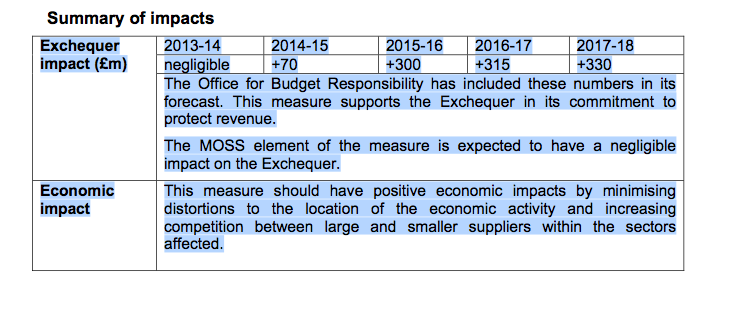
Let’s go back to the TIIN, to the summary of impacts that starts at the bottom of page A112.
Screenshot 2015-02-05 14.14.50

The first line shows you how much money the government expects to get as a result of this change.  The numbers are in millions of pounds, and the plus sign means the government expects to get this much tax in from the change.

The first few months of 2015 are still in the 2014-15 tax year (the tax year runs from 6th April one year to 5th April the next year).  So between January 1st and April 5th 2015 the UK government estimates it will make £70 million in VAT from the changes.  In a full year, it thinks it will make an extra £300 million plus, with the numbers rising over time.

I think we can all agree three hundred million is a sum worth having.  For the government, it’s the cost of, say, the entire NHS radiotherapy service (table 9 page 28, 2011-12 figures).  But look at this: “The MOSS element of the measure is expected to have a negligible impact on the Exchequer.”

Now, I understand “negligible” in an impact assessment to mean “less than £100,000 across the entire affected population”, which is what it used to mean in 2012 when I was last working for the government.  But have a think about that.  The entire farrago of MOSS is expected to bring in less than a hundred grand?  Seriously?

Because one of the seven questions written into the tax original impact assessment proposals, and which was still there when I obtained the TIIN instructions and published them on my blog, is

why are you doing it this way???

Why the hell are you imposing this business-busting system on people from whom you expect to raise peanuts, when you’re still going to get the moolah you want from the big businesses it’s really aimed at?  Is this really the only way?

Option appraisal is one of the key elements of impact assessment methodology: generating and assessing all the possible ways of solving a possible policy issue and then choosing the best one, even if it’s the option to “do nothing” – that’s how governments tell themselves they solve problems.

So where is the options appraisal in this TIIN?

Don’t bother to look.  It isn’t there.

Look instead at the assessment of the economic impact.

This measure should have positive economic impacts by minimising distortions to the location of the economic activity and increasing competition between large and smaller suppliers within the sectors affected.

Well perhaps it “should”.  In an ideal world it would.  But in this imperfect world, HMRC completely overlooked the one-woman kitchen-table microbusiness and introduced a system which, far from “minimising distortions” and “increasing competition” will in fact wipe out the micro businesses or else drive them into the arms of the very businesses whose behaviour caused the policy problem in the first place.

A proper options appraisal might have included:

  • excluding micro businesses from the regulation altogether
  • allowing a longer lead in time before the regulation affected small and micro businesses
  • unilaterally setting a threshold below which the regulations do not apply
  • making payment processors legally responsible for operating the regulation
  • devising a MOSS which itself operated as a payment processor for micro businesses (instead of a paypal or worldpay etc button you could have a MOSS button – your money would come to you VIA the government, but come to you guaranteed VAT-compliant)

There might have been good reasons for and against any or all of these.  But if you don’t ask the right questions of the right people, well, you’ll never know, will you?


h1

Cost and value

January 21, 2015

How much does it cost to employ someone?

Let’s say an average wage is £27,000 – the kind of wage an officer in the Civil Service might get, for example.

The employer pays £27,000 plus employer’s NICs of around 3726 (£27k x 13.8%).  Call it about £30726 (ignoring other costs like accommodation, insurance…).

The employee gets a tax free allowance of £10,000 and a NICs threshold of 5772 and pays tax at 20% and NICs at 12% on the rest.  Say £3400 and £2548 respectively.

So the employer pays £30726 of which the employee gets £21,052 to take home and the government gets £9674.

OK.  Now.  Suppose the person doesn’t have a job.  Instead, they’re unemployed.  How much does that cost?

The government pays the person £72.4 a week in JSA.  They also pay them things like housing benefit (or temporary help with mortgage interest payments, if they become unemployed after they have started buying a house)  Those amounts depend on the person’s personal circumstances and I’ve run a few different scenarios through the helpful gov.uk benefits calculators.  If I were single with no dependants and no income and living in my current house with my current mortgage and council tax, then apparently I might be entitled to £157 a week in JSA, mortgage interest help and council tax support.  That’s £8164 a year (and, yes, is time-limited and dependent on circumstances but I take it to be a reasonable proxy for the sort of sum an ordinary working person might be entitled to)

Now let’s look from the point of view of the government.

Because of course the government doesn’t actually “pay” £30726 for an employee at £27000 a year.  The tax and NICs go back to the government, so the effective cost to the government is the amount the employee takes home, i.e. £21052.

And the difference between employing a Civil Servant on £27k and having them sit on JSA must, logically, therefore be the difference between £21052 and £8164, that is £12,888.

You see where I’m going with this, of course?  The government actually gets twenty seven grands-worth of work for twelve and a half grand.

Which is why, in the middle of a recession, it’s a daft idea to consider civil servants purely as a cost and not also as a benefit.

What kind of benefit?  Aside from the benefit of having money circulating in the economy, the well-being of the person employed in a proper job, and the virtuous circle of having working people in work and spending their money on fares to work, sandwiches at lunchtime and new clothes in which to look professional?

Well let’s think about tax penalties for a minute.  There is a bit of a theme developing in the tax press about penalties: are they fixed at the right levels?  Are they being used for a sensible purpose?  Are they actually achieving the objective of changing behaviour?

Here’s an idea.  Instead of letting trivial penalties mount up till they’re “worth” collecting, why not employ a new cadre of – let’s call them “advisory collectors”.  Send them out, in pairs, to knock on the doors of people who have incurred £100 penalties for failure to make CIS returns, or are late with their income tax self assessments, or have incurred 2% or 5% VAT penalties for an amount smaller than £400.  Let them collect the relatively small amounts of penalties due, and at the same time give advice and assistance to prevent the problem recurring or the penalties accumulating.

Useful work, I’m sure you’ll agree.  Why, they might even pay for themselves…

h1

First consultation response of 2015

January 9, 2015

Well this is odd.  The consultation on the withdrawal of another tranche of extra-statutory concessions (which closed at 11.45pm yesterday, 8th) was listed on gov.uk here.  There was one document to download, this one, which describes itself as a “technical note and call for evidence” and says

To date six consultations have been published seeking comments on such legislation, and a seventh is published today alongside this technical note.

Honestly, I wish they’d proof read this stuff!  I know they still have a consultation coordinator but perhaps “being irritatingly poorly proof read” isn’t a criterion for quality control.  That is, assuming the document actually *is* the consultation, and that there isn’t another document floating around somewhere on the HRMC website which didn’t make it across to gov.uk?

Anyway.

Here are the three concessions to be withdrawn.

EIM4 03002 – Professional remuneration

Sports testimonials

D45 – Capital Gains Tax: roll-over into depreciating assets

The first one seems to have been a “get out of operating PAYE” concession for DEFRA when they employed vets, so frankly I don’t care, sorry.  The third one has just been overtaken by new legislation and is plain obsolete.

The middle one?

Well you can see that a gentlemanly agreement to hold a testimonial match for Jenkins when he retired as the goalie for Obscurely Interesting United and returned to his full time employment as the local butcher might have made it appropriate to exclude the take from tax in the 1920’s.   This would be on the grounds that any monies Jenkins might have received were in respect of his sterling personal qualities and not an expected reward for his professional services.  But today?  When the pampered princes of the beautiful game could buy a house like mine every week from their earnings, can separate out their “image rights” (and keep them offshore), well, the belief that setting up a testimonial committee was sufficient to give them another tax-free sum wasn’t really in the spirit of the concession.

Yes I’m prejudiced: if just one of the Premier League players had put his hand in his pocket and sponsored the GB deaf women’s team’s fundraising efforts to go to the Deaflympics – funds they could have put in out of small change – I might feel differently.

On the other hand, the impact assessment says that

We understand that most of the bigger football testimonials will donate to charity – most of the Premier League testimonials noted recently have donated all funds raised (after costs incurred by the testimonial committee) to charities of the player’s choosing. In the bigger rugby and cricket testimonials up to 10% can be donated. These donations should not be adversely affected if individuals are encouraged to give using tax efficient methods such as Payroll Giving or Gift Aid, or by giving up all rights to the income.

And it’s in the impact assessment, so it must be true.

h1

Legislative gap? Legislative overload?

January 8, 2015

There’s a theory doing the rounds that the Coalition have run out of steam and are just coasting to the election date.  (7 May – in case you hadn’t heard!)

So where is the evidence?

You know where I’m going with this, right?  Yes, there are 2336 “publications” according to the front of the gov.uk consultations page today, of which 125 are open consultations (and, check figure, 2209 show up as “closed consultations“.  What are the other two???)

It’s January 8th today, the Thursday of the first full week back at work after the New Year for most people.  Quiet time, right, for catching up and getting organised?

Filter by “open consultations published after 1/1/2015” and you’ll find nine publications, ranging from how to comment on open access restrictions at Bickerley Common (which is a place in Hampshire where people walk their dogs but where birds like Bewick’s swan need to be protected from, er, eutrophication, whatever that is) to the Competition and Markets Authority’s draft Welsh Language Scheme which is out for consultation here (and which worried me a bit till I realised it was also out for consultation here in actual Welsh!)

Is that a lot, in a week?

I don’t know.  There were ten publications between 1/1/14 and before 9/1/14, and more organisations are migrating their web presence to gov.uk all the time.  There were 23 between the first and ninth of July (16 consultation outcomes and 7 new consulations) so maybe that’s about the going rate.

I don’t know.

It just seemed interesting to look at, that’s all.  As you were.

(But if you’re interested there are 9 open consultations about tax.  And this one closes at quarter to midnight tonight!)

h1

The “full” story

January 2, 2015

If only they had missed out the word “full”.

Yes, I know, “full story” or “full release” is how they signal all their press releases on their twitter feed.  But still, for a Press Office – presumably full of communications specialists – it’s a remarkably cloth-eared phrase.

There was a smidgin of good news in there.  If you follow the link to the HMRC press release you will see a brief account of the VAT changes which came in on 1 January, but with the smidgin of good news spun into a bushel of support, as in “UK digital firms get support with new EU VAT rules”.  But…

@HMRCpressoffice While I think HMRC have done some sterling work mitigating worst results, this whole #VATMESS was still a consultation fail

— Wendy Bradley (@wendybradley) December 31, 2014

The MOSS itself is a laudable attempt to give UK businesses a single place (a “Mini One-Stop Shop”) to deal with the multiple EU jurisdictions.  Letting small businesses register for MOSS without losing their UK VAT exemption threshold is sensible.  Conceding that they can use the location information provided by paypal and their ilk is helpful (albeit described as a “temporary” concession).  You can’t, I suppose, really fault the way HMRC have responded to the nano business community once they became aware of their existence.  But why on earth weren’t they aware of their existence before the twitterstorm?

What was needed was some outreach during the consultation and publicity process.  But HMRC seems to have consulted with the “usual suspects”: the representative bodies and professional associations comprised in their “stakeholder” base.  Which is less than helpful if you are dealing with nano businesses – kitchen table craft businesses – too small to warrant using an accountant, too small to cover paying membership fees for something like the Federation of Small Businesses.

There were organisations they could have consulted with: writers organisations, for example, would have known about self-published ebooks and about conventionally published authors using their own websites to sell ebooks of their long tail publications once they have won back the rights.

h1

Twitterstorm: a Modest Proposal

November 27, 2014

Twitter has its uses.  How else could a number of angry individuals get the attention of HMRC and bring their concerns to the table?  The “stakeholder engagement” concept that HMRC uses to decide who to talk to breaks down when the affected taxpayers are micro businesses who typically don’t belong to any of the representative bodies who have a seat at the stakeholder table.  All power, then, to the knitters, musicians, authors and others who have created a twitterstorm over the VATMOSS/VATMESS changes I described in my last post.

HMRC have responded by using their new @HMRCcustomer twitter presence to offer a “twitter clinic” on the changes, today (Thursday 27th November 2014) …. between 3.30 and 5pm.  This is another enormous brick they’ve dropped, as many of the affected businesses are part-time one-woman businesses fitted in around domestic responsibilities or full time jobs, so that during the school run is the worst of all possible times to offer to talk.  Sigh.

I have been thinking a bit about the proposed changes over the last few days and I have a Modest Proposal for a solution.  First of all, HMRC need to be absolutely explicit that, where someone sells via a platform (Amazon, Etsy, Ebay…) then it is the platform’s responsibility to sort out the VAT, and saying “we aren’t responsible for VAT” in their terms and conditions (as several smaller platforms apparently do) isn’t going to cut it.  It would be helpful if HMRC were to give some kind of clear assurance that people selling via (a list of platforms) needn’t worry about/engage with MOSS at all.

However.  Clearly it’s iniquitous that changes to close a tax avoidance loophole (allowing ebook sellers to use a platform registered in Luxembourg to avoid other jurisdictions’ higher VAT on ebook sales) are being introduced in a way which drives micro businesses into the arms of the platforms that caused the problem in the first place.  People who sell below the existing VAT threshold should continue to be able to sell the odd download off their own website without having to become VAT traders for a turnover that’s often below £80, let alone the £80,000 that would require them to be VAT registered.

So.  What we need is a platform which is

  1. revenue neutral (doesn’t cost you money to use)
  2. is co-operatively owned (on the Wikipedia or AO3 models perhaps) and
  3. does the job.

Now we could probably make one, given enough time (Kickstarter, anyone?)  But HMRC have regular meetings with their software development community stakeholders.  And they have modest funds to assist charitable causes connected with tax.  So maybe they could convene a meeting, urgently (seriously, next week) between interested software developers and the micro businesses who have contacted them via twitter, and they could kick in the first hundred grand or so to get the kickstarter off the ground.

Because really the easiest solution to the #VATMESS would be for the paypals and worldpays of this world to sort out the VAT when they collect the micropayments for the affected microbusinesses.  And if there were another, independent, cooperative payments organisation available who guaranteed that they did, well… competitition is supposed to be how capitalism produces innovation, right?  Let’s just give the micros a hand up.

There isn’t time before the changes are brought in on 1st January, you say?  Well, the Judicial Review process is there for anyone who feels that the legitimate expectation has not been met that a statutory instrument would only be introduced after the government has fulfilled the commitments it has made in the past to

  • consult with affected parties
  • “think small first” by taking into account the impact on micro businesses, and
  • give due regard to equality impacts

Judicial Review is expensive (who do we know who might be affected and has “willing to bet their house” kind of sums available?  The Prince’s Trust?  J K Rowling??) but (in my opinion as a former better regulation specialist in HMRC) there is an arguable case.  One remedy the courts could provide would be to send the government back to do the consultation again properly.  Which would delay implementation.  So they could, you know, just be good guys anyway and delay implementation for anyone below the VAT registration threshold for three months while an independent platform was developed via kickstarter.

Or they could just come up with a better idea on their own…

h1

VAT on ebooks

November 25, 2014

As it says on my twitter bio, I’m

By day, PhD Law student researching tax simplification and better regulation; by night, writer of science fiction and fantasy.

so today my Facebook and twitter feeds are suddenly full of people from the science fiction side of my life talking about tax.  Why?  Well, take a look at the hashtags #VATMOSS and #VATMESS.

Essentially from January the loophole that lets Amazon avoid charging VAT on e-books has been closed.  VAT will now apply at the rate applicable where the customer is located, and not at the place where the business selling them an ebook has been registered.

Except…

Except what about all of those authors who make a few quid selling their back catalogue as ebooks?  Do they have to register for VAT in France just because someone in their holiday home in Normandy logs on and downloads a single copy of their ebook for some poolside entertainment?

Ah, says HMRC, we’ve thought of that.  There’s a thing called the “mini one stop shop” – MOSS – which means you can register for VAT in just one country, the UK, and pay your French and German and Italian and Spanish VAT direct to the UK every quarter.

Wait a minute, though.  Doesn’t the UK have the highest VAT registration rate in Europe (£81,000) so they won’t have to worry about it till they are in the Big Seller Who Can Afford An Accountant category, right?

Wrong.  The MOSS threshold is zero.  Yup.  Any european sales and you have to register, make returns, keep records…

Now there are two issues here (yes, I know, there are dozens, but there are two that I want to highlight)

First of all, does the MOSS zero threshold apply to ALL sales, or just to MOSS-eligible sales (i.e. to business-to-consumer sales in European countries other than the UK)?  In other words, does selling the odd ebook to someone in the EU mean you have to start charging and accounting for VAT on all your sales, to everyone, for ever?

Secondly…. well, I’m a retired tax inspector.  I Speak Tax (up to a point).  I have spent some time this morning trying to find out the answer to the first question.  Yeah.  The HMRC VAT instructions are copious, but incredibly badly written.  (You don’t believe me?  Try this page and then tell me whether MOSS sales and non-MOSS sales go on the same return?)  The blogosphere and commentariat suggest the sky will fall on the heads of small business and HMRC sounds utterly clueless and complacent.  The Guardian’s small business network has a piece which includes a quote from HMRC which seems to answer my question:

A spokesperson for HMRC says the changes should only have a “small effect on administrative burdens.”

“Although a business needs to have a UK VAT registration number before it can register for the Mini One Stop Shop (MOSS) online service, provided it separates the cross-border part of its digital services business from the domestic part, it can voluntarily register for VAT on the cross-border business only.”

Which seems clear enough, although HOW someone who sells the odd e-book off a web site is supposed to know how to do that is a bit harder to fathom.  But the press office are quoted in the same article as saying:

The HMRC spokesperson says that it has provided a “significant amount of information” about the VAT rule changes and MOSS on the GOV.UK website. “We have worked closely with stakeholders and representative bodies to publicise the changes, been involved in various webinars, held a conference that was streamed on the web, and regularly issue Twitter alerts. We have issued regular updates over the last 12 months in the quarterly VAT Notes and we are organising a Twitter clinic that anyone can join to ask questions.”

Really?  This is a change which affects micro businesses, the muggles who don’t speak tax and don’t belong to any of your “stakeholder” organisations.  It seems to have been badly thought out, badly explained, and badly handled.  And now to have come up against an organised set of articulate and well connected tax muggles who aren’t going to stand for any nonsense.

*sits back and fetches popcorn*

h1

November consultations

November 5, 2014

There are 111 open consultations across government, according to the direct.gov website this morning.  Three of them are from HMRC:

Extra-statutory concessions: seventh consultation on draft legislation 27 November 2014 11:45am
Control of raw tobacco 30 January 2015 11:45pm
Withdrawal of extra-statutory concessions 8 January 2015 11:45pm

(Incidentally, ESC team, you know the idea of closing a consultation at 11.45 is to close it at quarter to midnight, not midday, right???)

So, although I’m focusing on my academic writing this month (yes, five days and counting of AcWriMo!) I will be back to look at the consultations, if for nothing else.

h1

Duck

September 16, 2014

Property again.  Was it the duck houses that irrevocably tainted the relationship between our government and the governed in the area of property policy?  Anyway, duck houses are the first things that come to my mind in connection with the idea we should reduce the administrative burden of the ATED – the annual tax on enveloped dwellings.

Because ATED is a rich buggers’ tax: it’s the “not-quite-a-Mansion-Tax” tax on houses that are owned by some kind of corporate entity to avoid Stamp Duty Land Tax.  The idea is that if you and I live in a house we own and then sell it we don’t pay capital gains tax but, if the house is worth enough, we have to pay stamp duty.  If we own two houses and sell one of them, well, we only get the CGT exemption (broadly) for one house at a time.  So if we had to sell the estate in Scotland to finance the country house in Berkshire we’d have to pay capital gains tax on the estate (pause for hollow laughter, because capital gains tax is a notoriously voluntary tax) and Stamp Duty Land Tax.  So we’d put the estate into a company, preferably offshore, and just sell the shares in the company instead, right?  Hence ATED, an annual tax on “enveloped dwellings” – houses that are put into some kind of corporate ownership rather than being owned by a natural person.

In that light, the fact that the tax only started in April last year and already the buggers are wanting the “burden” of administering the tax to be eased seems preposterous to me: the condoc says upfront that the entire aim of ATED in the first place is

to discourage enveloping, to encourage the de-enveloping of property and to ensure that those who continue to hold property in this way pay a fair share of tax

The consultation also says it should be read “by those currently within the charge to ATED… those who are likely to fall within the regime in the future, ATED practitioners and representative bodies” (Pause to boggle at the thought that there are already “ATED practitioners”)  Yes, I know that there are inoffensive businesses which have to claim exemption from ATED and it is, presumably, reducing the administrative burden on these which is the aim of the consultation.  They are listed as:

1) property rental businesses (including preparation for sale, demolition and conversion);

2) dwellings opened to the public;

3) property developers (including exchange of dwellings interests);

4) property traders carrying on a property trading business;

5) financial institutions acquiring dwellings in the course of lending;

6) dwellings used for trade purposes (occupation by qualifying employees and partners);

7) farmhouses (occupation for the purposes of carrying on a trade of farming) and

8) providers of social housing. (2.6)

You know, I might have been persuaded that there was some legitimate policy aim in here, if I hadn’t read on, past the list of inoffensive businesses to the list of those who have already been engaged in “informal discussions” with HMRC.

They’re helpfully listed in Annex A: let’s play “spot the one whose interests most closely align with your own.”

Barratts PLC

British Land Company

British Property Federation

Burges Salmon

Cadogan

Chartered Institute of Taxation (CIOT)

Clifford Chance

Council for Licensed conveyancers

Deloittes

Ernst & Young

FTI Consulting

Grosvenor

Hunters Solicitors

KPMG

Law Society

National Landlords Association

Rawlinson & Hunter

Smith & Williamson

Stephenson Harwood

Taylor Wimpey PLC

All worthy enterprises, of course, but what about the rest of us?  Isn’t this all really a bit like… asking MPs to decide their own expenses claims???


h1

Extra-statutory

September 15, 2014

Oh no!  I hope I don’t get delayed finishing this piece until after the consultation into Legislating Extra Statutory Concession D33 closes!  It closes at 3.30 today (because, reasons) so hurry along!

Actually that’s about the only comment I have on this consultation, sorry.  It’s a sensible idea – in the general tidying up of extra-statutory concessions that followed on from the  2005 Wilkinson case they have reached D33.  D33 was a sensible way around the possibility of a capital gains tax charge arising when someone received a compensation payment. Basically you’d get an imaginary “cost” or “value” of the right to take action equal to the actual amount you received, so you wouldn’t pay CGT.  There was a limit of half a million, after which you had to write to HMRC and ask nicely.

Now the limit is to be a million, and after that you pay CGT, but as the consultation points out, the courts will know that and, presumably, adjust the compensation accordingly.

Simplification that’s actually effective?  Well done!